

First Reformed (2017)
Paul Schrader
Cast: Ethan Hawke, Amanda Seyfried, Cedric the Entertainer, Philip Ettinger
Length: 113 min
Country: United States
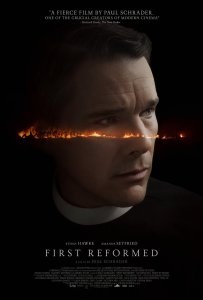 Paul Schrader’s career is just astounding. Screen-writer for many of Scorsese’s masterpieces as Taxi Driver (1976), Raging Bull (1980), and The Last Temptation of Christ (1988), he is also a film critic, writer, and of course director of films like American Gigolo (1980) and Mishima: A Life in Four Chapters (1985). His filmography is exceptionally varied and somewhat erratic. Giorgio Moroder and David Bowie’s modern soundtrack didn’t save his horror remake Cat People (1982) for me, and his Canyons (2013) starring Lindsay Lohan and porn actor James Deen was just unbearable.
When I heard that First Reformed was Schrader’s return to form, I couldn’t help being both curious and sceptical.
I am pleased to say that even if flawed, First Reformed probably Schrader’s best and most personal work (since he almost became a priest himself) in at least 20 years. A movie filled with an insidious sense of despair, spiritual ordeal and hopelessness for the future that is comparable with behemoths of cinema as Bergam and Bresson.
Schrader seems to borrow elements especially from Bergman’s Winter’s Light (1963), where a Swedish pastor is suffering from a severe crisis of faith once confronted with God’s everlasting silence. Similarly, First Reformed is an intimate portrayal of a man of faith faced with devouring darkness, so intimate that it feels like we are peeping inside a confessional booth.
Set in present-day upstate New York, it follows the secretive life of Reverend Ernst Toller, custodian of the First Reformed Church, played superbly by Ethan Hawke who is on top of his game. He decides to start writing a personal diary as an experiment, where he shares with an invisible audience his struggle in adjusting to the increasing overlapping between church and capitalism. At the end of one year of writing, he will shred and burn the diary.
First Reformed Church became more of a gift shop than a place of spirituality, attracting more tourists than congregants. Only a handful of people are sitting on the white pews, listening to his sermons. Among those people, there is a young pregnant woman named Mary (Amanda Seyfried) whose sacred name can only add more layers to this film.
She approaches the Reverend after the service, asking him if he could talk to her depressed husband, Micheal. He is a radical environmental activist whose in-depth knowledge of the irreversible consequences of climate change destroyed his faith in the future. He doesn’t want to bring another child into this world. By the age of 33 (Jesus’ age at the time of his crucifixion), his daughter will be doomed to live in a world devastated by the greedy nature of our individualistic society. Rather than bringing some peace to Micheal, that conversation opens a dark spiralling hole inside Toller’s spirit, rekindling his grief for the death of his son who was killed during the Iraq war. “Will God forgive us for what we have done to his creation?”.
These words echo in the Reverend’s mind with relentless persistence. God is in every flower, every bee, every forest and coral reef. The planet is dying, and nobody seems to care. The “Abundant Life” corporate church not only appears to be completely clueless, but it is even sponsored by the mayor, governor, and a well-known industrialist, Edward Balq.
The Reverend is feeling alone and betrayed by his congregation.
As if that wasn’t enough, an aggressive cancer is spreading inside Toller’s body, similar to the looming devastation on planet Earth. He tries to post-pone a doctor’s appointment (a nod to humanity’s procrastination in facing the consequences of global warming). He is angry and in denial after the preliminary diagnosis (a nod to climate change deniers). His only cure for his physical and spiritual turmoil is alcohol. In one scene, we see him pouring candy pink Pepto Bismol in his whiskey. The image of this pink invasive mass, spreading inside this transparent liquid visually resembles the idea of a tumor, as well as the entropy effect that can only lead to a slow decline into chaos.
What do you do when there is no hope? Do you keep fighting or do you acknowledge the inexorable destiny? Should we keep trying to protect our planet, or maybe accept its premature deterioration?
Confined in a boxy aspect ratio (the same one used by Pawlikowski in Ida, 2013), Schrader’s approach is realistic and austere, nostalgic of an era of cinema that relied on its simplicity and not on superfluous embellishments. However, there are few surreal elements in stark contrast with the bleakness of the rest of the film. Without going into many details, there is a scene in particular where Mary and the Reverend will experience a sort of metaphysical connection. The scene fails to reach the cinematic resonance Schrader was hoping for, due to its preposterous editing which lies between the ludicrous and the extraordinary.
The climatic, eventful and abrupt ending will probably divide the audience as well.
It could be that Schrader didn’t know how to end it and couldn’t be bothered to write a final chapter. Or possibly, that his ending is instead very well- thought out, multi-layered and open to multiple interpretations. I prefer the latter option.
Is what happening on screen real or is it a manifestation of God? Is it a Miracle or the imagination of a dying man? Or is it just Heaven itself? Why is there a distracting eye-shaped lamp in Mary’s apartment? It’s left to the bewildered audience to decide, and our answer might tell us how much faith in humanity and the future we have left within ourselves.

Movies you might like if you like First Reformed:
Diary of a Country Priest (1951) by Robert Breton
Winter’s Light (1963) by Ingmar Bergman
Breaking the Waves (1996) by Lars Von Trier
Ida (2013) by Paweł Pawlikowski
 Film Criticism and Cinephilia
I haven’t seen First Reformed (whereas I have seen Cold War). What struck me most was the clarity of the plot synopsis: you’ve done a good job of giving me a clear sense of the dramatic conflict, themes and tone of the film. You’ve even intrigued me enough to consider watching it (which I didn’t think was possible for a Paul Schrader film!).
LikeLike