Week 12: Challenging tastes: cult cinephilia

  • How do the readings characterise/define ‘cult cinema’ and ‘trash cinema’?

Garfinkel stated that not all cult films are trash and not all trash films automatically receive a cult status. The two definitions often intermingle and their differences increasingly narrow. Cult Cinema incorporates a wide variety of films which are difficult to categorise.  Popular films such as The Big Lebowski and Fight Club, film oddities such as Rocky Horror Picture Show and Harold and Maude and re-evaluated classics including Freaks and Peeping Tom are all considered cult movies.
Trash Cinema is often linked to ‘exploitation films’, containing an abundance of violence, gore and nudity:

What defines cult is not the film itself, but its audience. It’s the fervent enthusiasm of its niche spectatorship that gives the cult status to non-mainstream films. The Midnight Movie became a cinematic phenomenon in the early ’70s when small theatres started late-night screenings of bizarre cinematic creations. Films like the acid western El Topo were screened at the Elgin Theatre in New York City, aiming at building an audience for counterculture films. In the 80’s the cult following moved to the small screen with the advent of videotapes. Usually, subgenres such as blaxploitation, sexploitation, Nazi exploitation, nunsploitation, Mondo films and Italian Giallo were released straight to VHS, also known as “video nasties”. The existence of distasteful horror was not ephemeral anymore. A moviegoer could own the film, pause it, rewatch it and rewind it several times.

Trash cinema is strictly related to class and sexuality. It became a form of expression for the marginalised voice in society, especially for queer audiences, critics and filmmakers. Andy Warhol, John Waters, Derek Jarman and Kenneth Anger treated “trash” as a crude form of artistic expression. It offered a shocking alternative to high culture and the mainstream to an audience bored by the formulaic “proper” model of Classic Hollywood Cinema.
All these films trasgressively refused conventional ideas of beauty and taste. They were vulgar, kitsch, camp, over the top and often surreal. Thus, they share many similarities with the surrealist movement (Dalí and Buñuel’s Un Chien Andalou) as well as conceptual art (Duchamp’s urinal). “Trash cinema” is imbued with cultural fears and repressions and evokes the primordial scope of cinema to transform reality.

  • What does cinephilia and cult cinema have in common?

Hunter analyses the subtle differences between cinephilia (which tends to be more interested in “high culture) and cult cinema (which tends to be more obsessed with “low culture”). However, the similarities are more than the contrasts. Mainstream Cinema seems to marginalise these modes of film watching. Whether you call them “film-maudits” or “film freaks”, they are films that are working outside the constrictions of Hollywood Studios and their rigid narrative formulas. Both audiences have a certain sensitivity and awareness towards what alternatives the film universe can offer. They both actively seek out rare gems, whether it is The Cabinet of Dr Caligari or Pink Flamingo. The line between the two gets thinner when Hitchcock’s Vertigo -which was labelled as trash when it came out- it’s now 1st on the BFI 100 Greatest Films of All Time. What was considered “trash” in the past might be considered “art” in the present and vice versa.

Both the cinephile and the cultist share the same appreciation for films authorship. They both celebrate the audacities of the creators and position the director on top of the hierarchy as an auteur. Filmmakers such as Argento, Fulci and Waters have distinctive trade-marks and idiosyncrasies which make them subjects of study and admiration.

  • How do the authors conceptualise ideas around high and low culture? Do they mention the middle-brow?

“High Culture” is associated with ciné-clubs, European art-house screenings, film magazines, film festivals and Criterion Collection DVD editions. On the opposite side of the spectrum, “low culture” tends to be associated with American pop culture, Midnight movies, body horrors, Arrow films, naughty postcard, pulp novels and pornography. According to Hunter, the idea of “high art” was conceptualised with the advent of  the modernist art movement which labelled as “junk” what was considered popular and accessible.  “High art” is accessible only for those few with enough knowledge and interest to grasp it or appreciate it.  “High culture” seems to be defined by critics and gate-keepers, whereas cult cinema is defined by its audience. Films considered to be part of “low culture” are often raw, poorly directed, and low budget. They aim for the spectators’ bodies rather than their minds. Low Culture is more often than not corporeal.

Hunter refers to the middle-brow in relation to films that once were acclaimed and then forgotten. The middle-brow seem to be the “forgettable”, textbook films made by American studios which are formulaic and generic and don’t stand the test of time.
 

Week 10 Retrospectives and re-evaluation

Revolt She Said: Women and Film after ’68 (tour)

  • What was the aim of the event?

Curated by the feminist collective Club du Femmes, “Revolt She Said” is a UK film tour of widely unknown and forgotten films directed by women about women. The tour strives to introduce more female directors into the canon of what is considered “essential cinema”. Left at the periphery of a predominately male film culture, the vast majority of these films are in part responses to 1968’s movements.

  • How does it relate to issues around ‘retrospection and re-evaluation’?

It is often men who produce, direct, write, exhibit and judge films. “Club du Femmes”‘s wide programme shows an increasing need in facing this long history of imbalanced representation, artistic freedom and exhibition.  By looking back into film history and searching for hidden gems, “Revolt She Said” focuses on films which from day one were doomed to be overlooked. Women filmmakers struggle to find funding and distribution. Still today there is a huge imbalance in both the film industry and film criticism of female talents. I was particularly shocked in going through this programme and struggling to find any familiar names (The only names familiar to me were Agnes Varda and Lucretia Martel). There is also an interest in short films, which tend to be excluded completely from film discourse.

  • Do they position any films as ‘forgotten’ or ‘lost’ classics? If so, which ones and how?

It doesn’t look like they specifically use the word “forgotten” or “lost” to describe any of these films. Maybe because they are all “forgotten” in a way. There is a sense that the programme in its entirety is focused on lesser-known films. The Cat Has Nine Lives has been restored and screened for the first time in 50 years. Lizzie Borden wrote an on the feminist gaze in Maeve, a film which hardly anyone saw.  She considered it timeless, urgent and still relevant at the time of Metoo. Perhaps even more buried are films directed by black women as A Place of Rage by Pratibha Parmar. A documentary which celebrates African American women and their achievements in the midst of civil rights movements. There is a focus on the past of feminist cinema, but there were also a few screenings dedicated to new female voices, such as greek directors Athina Rachel Tsangari (Attenberg) and Konstantina Kotzamani.

  • Write a paragraph reflecting on ways you could develop this into a more sustained piece of research (as a hypothetical idea, not as something you will then actually have to do).

To effectively change the canon, I believe that the focus should aim to the next generation of viewers. Introducing these unknown films to teenagers could be an inspiring and educational lesson. I myself am someone who relied on these “Top 100 lists” to improve my film knowledge in the first place. It would have been extremely beneficial to have learnt at the time that there is a diverse range of voices beyond those lists. To make this retrospective tour more effective in the long run maybe they should be introduced into History and Art programmes around the country. Perhaps through lectures, screening and workshops.


Bibliography MLA for my essay “Cinema of Enduring Cruelty: An evaluation on the use of the long take in Poppe’s Utøya 22 July and Haneke’s Hidden”


Blumenthal‐Barby, Martin. “The Complicit Gaze: Michael Haneke’s Cinema of Guilt.” The German Quarterly, vol. 89, no. 2, 2016, pp. 202-220.

Celik, Ipek A. “”I Wanted You to be Present”: Guilt and the History of Violence in Michael Haneke’s “Caché”.” Cinema Journal, vol. 50, no. 1, 2010, pp. 59-80.

Connolly, Kate. “Utøya Massacre Re-Enactment Stuns Berlin Audiences.” The Guardian, 2018.

Daney, Serge. “The Tracking Shot in Kapo.” Senses of Cinema: An Online Film Journal Devoted to the Serious and Eclectic Discussion of Cinema, vol. 30, 2004.

Ebert, Roger. “Irreversible Movie Review & Film Summary (2003) | Roger Ebert.” RogerEbert.com, 14 Mar. 2003, http://www.rogerebert.com/reviews/irreversible-2003.

Gibbs, John, and Pye, Douglas. “Introduction 1: The Long Take – Critical Approaches” found in The Long Take: Critical Approaches. 1st ed., Palgrave Macmillan, 2017.

Grossvogel, D. I. “Haneke: The Coercing of Vision.” Film Quarterly, vol. 60, no. 4, 2007, pp. 36.

Kinsman, R. P. “She’s Come Undone: Chantal Akerman’s Jeanne Dielman, 23 Quai Du Commerce, 1080 Bruxelles (1975) and Countercinema.” Quarterly Review of Film and Video, vol. 24, no. 3, 2007, pp. 217-224.

Lebrecht, Norman. “Out of the Archives : The Horror Film That Hitchcock Couldn’t Bear to Watch.” Sunday Times, 1984.


Mitchell, Wendy. “Utoya Massacre Film ‘U – July 22’ Will Focus on “the Young People”, Says Director.” Screen International, 2018.


Palmer, Tim. “Style and Sensation in the Contemporary French Cinema of the Body.”Journal of Film and Video, vol. 58, no. 3, 2006, pp. 22-32.

Price, Brian. “Dossier on Michael Haneke: Pain and the Limits of Representation.”Framework, vol. 47, no. 2, 2006, pp. 22-29, 35-48, 51-59, 66-79, 127-145.

Pritchard, Tiffany. “It was ‘Important’ to make Utoya Massacre Film ‘U-July 22’, Says Survivor.” Screen International, 2018.

Rhodes, John D. “Haneke, the Long Take, Realism.” Framework: The Journal of Cinema and Media, vol. 47, no. 2, 2006, pp. 17-21.

Rivette, Jacques. “On Abjection”. Cahiers du cinema vol. 120, 1961, pp. 54-55. (Translated by David Phelps with the assistance of Jeremi Szaniawski.)

Robson, Melanie. “Complicity, Intimacy and Distance: Re-Examining the Active Viewer in Michael Haneke’s Amour.” Studies in European Cinema, vol. 14, no. 2, 2017, pp. 103.

Saint-Cyr, Marc. “Slow Fuse: The Cinematic Strategies of Tsai Ming-Liang.” Cineaction, no. 85, 2011, pp. 9-14.

Speck, Oliver C. “The Moral of the Long Take” Funny Frames: The Filmic Concepts of Michael Haneke. Bloomsbury Publishing, London, 2010, pp. 178-182.

Sontag, Susan. Regarding the pain of others. New York: Picador, 2003

Stewart, Garrett. “Pre-War Trauma: Haneke’s “the White Ribbon”.” Film Quarterly, vol. 63, no. 4, 2010, pp. 40-47.

Thorpe, Vanessa. “Utøya Survivor: Anders Breivik Massacre Films ‘Don’t Tell Full Story’.”The Observer, 2018.

Uricaru, Ioana. “”4 Months, 3 Weeks and 2 Days”: The Corruption of Intimacy.” Film Quarterly, vol. 61, no. 4, 2008, pp. 12-17.

Wood, Chris. “Realism, Intertextuality and Humour in Tsai Ming-Liang’s Goodbye, Dragon Inn.” Journal of Chinese Cinemas, vol. 1, no. 2, 2007, pp. 105-116.

Wynter, Kevin. “Excesses of Millennial Capitalism, Excesses of Violence: Several Critical Fragments regarding the Cinema of Michael Haneke.” Cineaction, no. 70, 2006, pp. 39-45.

Yervasi, Carina. “Dislocating the Domestic in Chantal Akerman’s Jeanne Dielman.” Sites: The Journal of Twentieth-Century/Contemporary French Studies Revue d’Études Français, vol. 4, no. 2, 2000, pp. 385.


Filmography

Akerman, Chantal, director. Jeanne Dielman: 23, Quai Du Commerce, 1080 Bruxelles. New Yorker Films, 1975.

Bernstein, Sidney, director. Memories of the Camps (AKA) German Concentration Camps Factual Survey, British Film Institute, Imperial War Museum, 3 Generations (2017 North American release), 1945.

Greengrass, Paul, director. July 22, Netflix, 2018

Haneke, Micheal, director. Funny Games, Concorde-Castle Rock/Turner,1997

Haneke, Micheal, director. Hidden, Les films du losing, 2005 .

Haneke, Micheal, director. Code Unknown. MK2 Editions, Artificial Eye, Leisure Time Features, 2000.

Hitchcock, Albert, director. Rope Transatlantic Pictures, 1948

Ming-liang, Tsai, director. The Wayward Cloud. 20th Century Fox (Taiwan) Axiom Films (UK and Ireland), 2005.

Mungiu , Cristian, director. 4 Months, 3 Weeks and 2 Days. BAC Films, 2007.

Noé, Gaspar, director. Irréversible. Les Cinémas De La Zone, 2002.

Poppe, Erik, director. Utøya July 22, Nordisk Film, 2018.

Wells, Orson, director. Touch of Evil. Universal Pictures, 1958.


Week 5. Audiovisual Essays: Criticism and research practice


  • Write a short analysis of mise-en-scene in Mandy (200-250 words), focusing on a memorable moment or scene. You can add this to the WordPress blog as a ‘Review’ (rather than a reading).

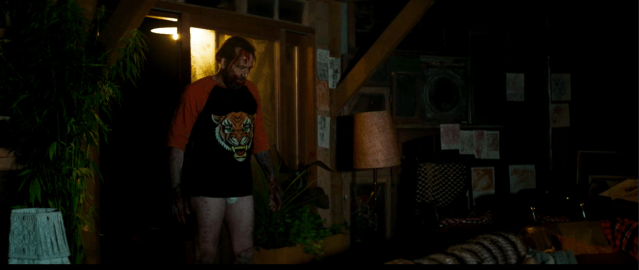
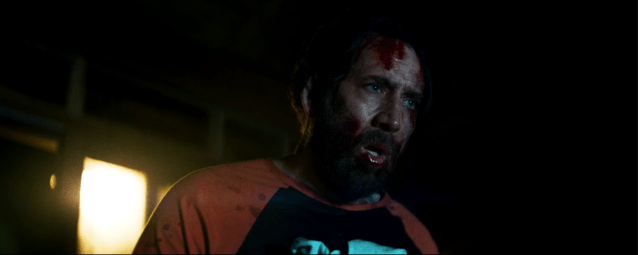
I really doubt that Godard would have called the scene I am going to describe as one of those “privileged moments” in films. However, this scene, in particular, stands out to me for its bizarreness concerning style and narrative. It happens shortly after Mandy was brutally burnt alive in front of her lover Red by a sadistic religious cult. Red is coming inside their home just after going through Mandy’s ashes. This next scene feels entirely in contrast with anything else.

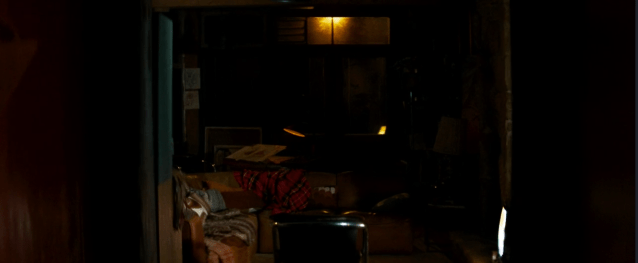
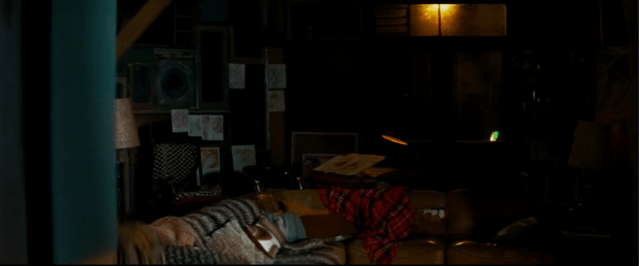
The camera moves from inside the house. We can see Mandy’s drawings on the wall and Red’s lumberjack shirt on the sofa. The room is dark save from the light from the television and the lightbulb outside.

Mandy 1Mandy 2

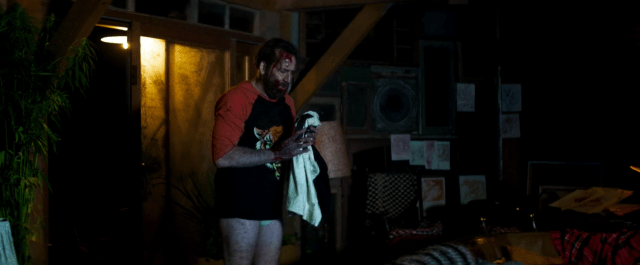
The camera stops at the entrance. We see Nicolas Cage character enter the room in a state of shock, covered in blood, wearing a kitsch sweater with a tiger on it and only his underwear. He finds on the floor Mandy’s jumper, and he picks it up.

Mandy 4Mandy 5

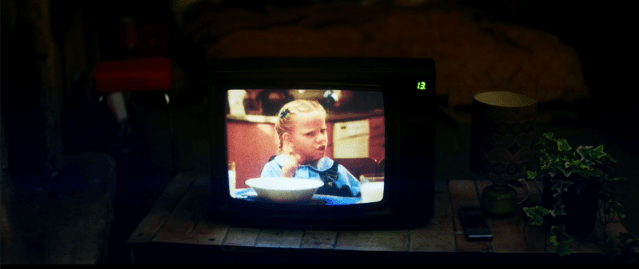
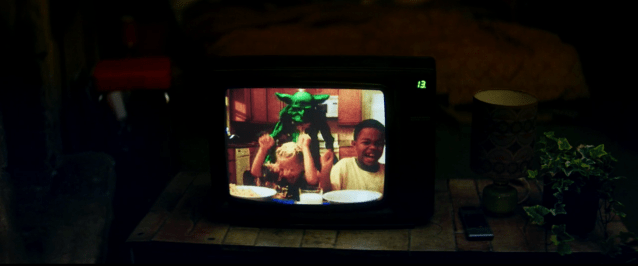
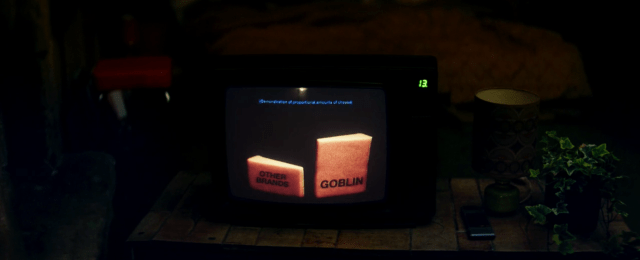
It cuts to the television screen, placed at the centre of the shot, where a grotesque and disturbing cheddar advert is playing. Reminiscent of 80’s horror aesthetic of B-Movies like the Troll 2, and the Gremils. We see a group of green goblins regurgitating cheese on two overly enthusiastic children.

Mandy 6Mandy 10

Red is as hypnotised by the television screen, sharing the same bewilderment of the audience. At the end of the advert, we see a demonic goblin slowly emerging from the cheese. Something is deeply unsettling about the eyes of the goblin looking towards the audience, almost like if an insidious darkness entered Red and Mandy’s peaceful home and belongings.

Mandy 7

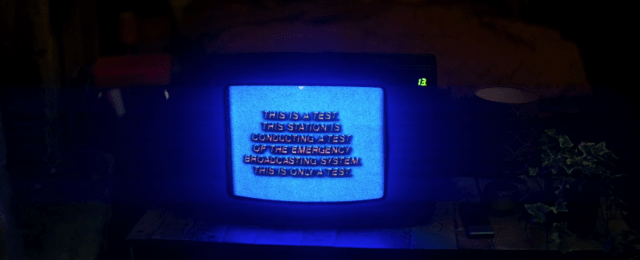
Red leaves the screen, going towards the bed, while we are still looking at the television screen. A plain blue emergency broadcast test interrupts the regular channel. The written words on the screen underline how “this is just a test”, implying that there aren’t any real emergency.

Screenshot 2018-10-24 15.44.58

Mandy 9

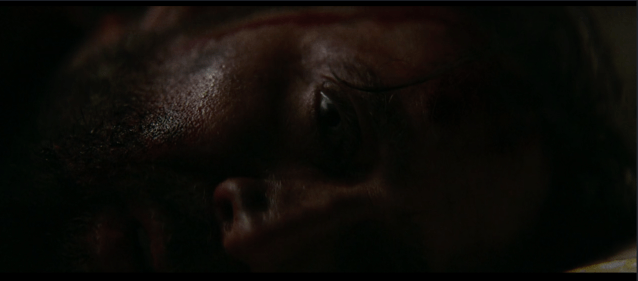
Red collapse into bed still in shock.

Mandy 12

  • The readings by Lavik and McWhirter cover similar issues, and will also recall ideas from Keathley’s piece on the video essay from Week 3. Thinking about all three pieces, identify 2 or 3 ‘key debates’ about audiovisual/video essays as a form of film criticism and/or film scholarship.


The Internet multimedia capabilities expanded immensely the possibilities for what constitutes film criticism. Now, we can access the vastness of information around film culture from the screen of our laptop. More comfortable, friendly-user editing softwares have made it possible for “amateurs” to learn editing skills. Moreover, digital criticism allows more flexibility and thanks to comment-sections, criticism is going towards what seems like an ongoing conversation about cinema rather than a verdict.

Finally, critics and scholars can incorporate moving images and sounds to their object of analysis. The opposite approaches that these new forms of criticism are shaping into, raise questions on the very definition of “video essay”.
In this multimedia spectrum, we have a more explanatory, analytical, language-based approach on the one hand, and a more poetic and expressive approach on the other. In “The Substance of Style” Matt Zollers Seitz closely analyses Wes Anderson’s entire body of work as well as his past influences and his substantial impact on contemporary filmmakers with a cohesive and precise 5 part video essay. Whereas Kevin B. Lee focuses on radical filmmaking, exploring the history of anti-colonialism by engagingly using little-known films. These video essays still rely a lot on the written language and spoken words, which according to Lavik it’s an essential part if you want to make a clear and articulate video essay which is not just ornamental.
On the other hand, the majority of these new audiovisual essays seems to borrow more elements from the avant-garde movements than from documentary practices. “Essay film” was a term coined in 1940 by experimental animator Hans Richter. They were abstract, difficult to grasp and at times impenetrable. Great filmmakers from the French Left Bank as Chris Marker and Alain Resnais were using visuals as their only language.
Jim Emerson’s “Close-Up” is a collage from classic films with no narration. The result is an evocative meditation on the medium of cinema itself. Others video essays seem more obsessed with smaller details, or patterns in films. For instance, Christian Marclay’s monumental collage “The Clock” is a looped 24-hour video montage of scenes from film and television that feature clocks.
Many of these audiovisual work better in art galleries than in academia presentation, more as a homage than a pondered evaluation.

Why is audiovisual criticism still at its embryonic state? Probably due to the technophobia of film critics and scholars who never learned to edit or lacked the resources. Often the most successful video essayists had a background in film practices. However, it seems like more and more critics are willing to learn these new skills or to collaborate with more technically skilful people. Now we have many digital platforms available dedicated exclusively or partially to video criticism, as Indiewire’s Press Play, Fandor’s Keyframe, and The Museum of the Moving Image.

The last issue concerns intellectual property. Many critics are unaware of their power when using copyright material. The Fair Use Act protects the audiovisual critic when it comes to using images and sound from films since the purpose is purely educational.


Week 4: Critical ideas: Auteurs, mise-en-scene and the ‘cinematic’

  • Why is the concept of mise-en-scene so important to the development of auteur criticism?

Initially ignored from the critical discourse, films like La Regle Du Jeu, Les Dames Du Bois De Boulogne and Orson Welles’s body of work where clear examples of what film theorist Alexandre Astruc would have called the age of “la camera-stylo” (camera-pen). He was among the first to theorised that cinema became a form of expression as compelling as painting and literature: A new visual language which can be flexible and versatile as much as the written words. A filmmaker can express, or as Astruc would it put, “write” his thoughts however abstract they may be through the use of the camera. Lighting, costumes, use of colour, camera angles, props, décor, framing, make-up and hairstyle and even the actors’ performance became malleable elements to determine the director’s vision. These elements and their interactions are what film critics at Cahiers Du Cinema called “mise-en-scene”.
The mise-en-scene is e terminology which finds its origin in theatre and means “put on stage.” In cinema, it usually also encapsulates some elements of post-production as editing, sound and music. The director has the last word on every aspect of the film, from the way the characters are positioned in the screen, the way the camera draws attention to small details, or intentionally avoid that or even on the length of the shot.
Critics from Cahiers Du Cinema as Truffaut, Rivette, Godard and Rohmer (Who all became active and prolific members of the Nouvelle Vague) used the mise-en-scene as a way to look at films more intimately. They re-evaluated more popular movies which often were overlooked by the critics and diminished as formulaic and low-brow. Their idea of mise-en-scene was fundamental to determine the director authorship and find exciting glimpses of individuality within Hollywood Studio films. Westerns, melodramas and romantic comedies deserved the same critical attention of what was considered high art. Studio directors as Howard Hawks, Douglas Sirk and especially Nicholas Ray managed to have a consistent and recognisable style throughout their careers.
Ray shot Johnny Guitar in beautiful technicolour with a distinctive colour palette and compelling climax. On the surface might look like a typical western, but its feminist subtext adds layers to its visual richness. All his films share similar themes and stylistic choices which might go unnoticed if it wasn’t for this new “way of looking” developed in the 50s.
Godard was searching for “privileged moments” in films, scenes which he found memorable and he was willing to share with other like-minded cinephiles. Rivette, while reviewing Angel Face by Otto Preminger, talked about “reason d’être”, (reasons for being). As Godard, he observed the small moments, particular gestures and attitudes which made some of those films so captivating. They were both searching for the film’s essence. Mise-en-scene became a way of seeing as well as a way the director dispose of objects and people. Those moments required an active close observation of films. The individual and unique way each director chooses to capture that cinematic essence is what they call authorship. “A subtlety of style, one that does not call attention to itself.”

Week 3: New forms: Digital film criticism

  • Frey’s essay is a good example of academic research into digital film criticism. Having read the whole thing, write a paragraph summarising his overall argument, approach and research methods (e.g., think about how the essay is structured, what kinds of examples and evidence he uses, and why). How persuasive do you find his argument?

By condensing a wide range of case studies and examples, Frey mistifies the rising anxieties in the world of cinephilia around the loss the authority of the critic and the decline into “dumbed-down” critical writing. An example that summed those concerns was the marketing campaign for J. A. Bayona’s The Impossible (2012), whose poster was costellated by users reviews rather than film critics’ taglines. It opened many questions around the “democratisation” of the Internet, whose widespread promote an expanded and inclusive public sphere, as well as, thinning the line between professionals film critics and amateurs movie-goers.
Frey reassures the reader, by avoiding any discouraging and fatalistic scenarios, but instead exploring the complexity and nuances of the digital age. He presents four significant trends.
1) Online Film Reviews of traditional print news, magazine and journals (Ex. Peter Bradshaw’s reviews for The Observer).
2) Sites designed to communicated about films, which also offer forums open to every user (Ex. IMDB).
3) Film dialogue on social media platforms as Facebook and Twitter.
4) Aggregate sites where hyperlinks connect to external sites. (Ex. Rotten Tomatoes, Metacritic, etc.).

Frey deepens into his investigation using Rotten Tomatoes as the central case study. Differently, from IMDB, RT tries to be a rigorous “objective” and unbiased platform for film evaluation. 60% positive response marks the line between a decent “Fresh” film and a mediocre “Rotten” film. This percentage is calculated by considering both the evaluations from a comprehensive selection of established critics and the opinions from the members of the audience. Thus, Rotten Tomatoes seems to offer a more consistent and “objective” experience of criticism, it allows greater access to a more diversified range of voices, and it increases the degree of participation and the sense of community.
The authority of the critic is not questioned as many might fear, since even the layout of RT priorities the opinions of the “Top Critics” which users can follow according to their individual taste. However, the idea of the utopian online “community” is hardly accurate. Readers tend to reinforce their views, values, prejudices and taste, rather than challenging them. In some extreme cases (Ex. The Dark Kight Rises 2012), online users react with threatening, derogatory and misogynistic comments once confronted with negative opinions around a film. The RT community feels homogenous even in its demographic, considering that the vast majority are between 18 and 34 years old middle-class men.

I found Frey analysis very persuasive. I often share the same concerns around the widespread of the internet that Frey broke down into well-pondered arguments. He supports his opinion with a wide range of case studies which I found compelling and rational.

  • How does Keathley characterise the changing relationships between ‘scholar’ and ‘critic’ in the digital age?

The advent of DVDs offered new ways for film critics, and film lovers to watch cinema. Features like freezing the frame, slow motion and infinite replayability, meant that the viewer could own the film and watch it “closely”.
Textual analysis stops to be a restricted academic practice, but a work of cinephilia. The widespread of the Internet changed the world of film academia, film journals and magazines, as well as, opened new doors for film analysis.
Keathley explained how the world of cinephilia writing became less steadfast and the distinction between scholarly and non-scholarly less obvious. Between the 60s and the 70s, film journals as Sight&Sound, American Film, Take One provided articles, news and insights around films to the middle range of non-academic cinephiles. In the 80’s magazines geared towards mainstream cinema emerged. With the internet, most of these magazines have moved online, and much of the online film criticism takes for granted that its readership includes both the non-academic and the film specialist.
Thanks to user-friendly editing software and access to high-quality stills and videos, some directors, film critics and film lovers found new ways to think about films. Video Essays like Jean Luc Godard “Histoire du Cinema” became a more poetic and expressive form of cinephilia. Some of these essays explored details of the body of work of directors like Rossellini, Ophüls, Anderson, Wells and Truffaut, trough video collage of images and sounds, words and music. Alexandre Astruc, at the time of the Nouvelle Vague, talked about cinema as a form of imaginative writing, “camera-stylo”.

  • How has digital technology affected film criticism? (Last week’s question was about cinephilia.) Note specific issues and new forms, drawing on all three readings (i.e., including Shambu if you have time).

The digital age is a shifting point in the discourse around film criticism which has caused enthusiasm and turmoil, acclaim and disdain in equal measures. Many fear for the role of the authority of the critic to be in danger. Others are excited to have a more inclusive and “democratic” platform for film discussion. Frey dissects those anxieties with clear arguments and case studies, underlining how the vastness the internet reinforced the authority of the critic, instead of demolishing it.
Online film reviews from established online journals (Peter Bradshaw from the Observer) and online presence of film critics on social media platforms as Twitter and Facebook show a wide disparity of views and followers between professionals and regular users. Anyone can open a film blog, but the chances to have your work read and shared among the infinite daily online content are as little as the chances to win the lottery.
Rotten Tomatoes bolstered the role of the critic, which position as gatekeeper is essential to decide how “fresh” a film is. Rotten Tomatoes praised the more established film experts with the title of “Top Critic”, through a series of rigorous criteria.
In Keathley’s chapter on video criticism, he investigates how the coming of multimedia platforms allows critics to analyse films beyond solely writing. Video Essay as Paul Malcolm’s “Notes Toward a Project on Citizen Kane”, manipulates footage from the work of great directors, juxtaposed with different use of sound and music which match the tone of the images (Ex. Sigur Ros).
Meanwhile, on platforms like Twitter and Facebook more concise and shorter forms of criticism take place. Shambu called this “micro-criticism”, a regular online practice where the writer in few words record observations, try out ideas, risk hypothesis on films and filmmaking.

Week 2: Cinephilia – old and new

  • How do Sontag and Shambu characterise cinephilia? (Think about the kind of language they use, as well as the kinds of practices they describe)

Sontag and Shambu seem to be at the opposite side of the same spectrum. Sontag’s view on the future of film culture and cinephilia is fatalistic. She looks back with nostalgia to the time when the fervent cinephilic dialogue was at the core of the French youth and the moviegoers’ routines in the 60’s and 70’s. She praises the immersive feeling of being inside a movie theatre among strangers and how this is slowly disappearing due to the widespread of television and commodities. She states that film lovers with a broad taste and extensive knowledge of film history and geography do not exist anymore and that cinema itself died with them. Sontag wrote this article in 1996 before the Internet changed the industry forever.
Shambu responds to Sontag’s absolutist approach in The New Cinephilia. He doesn’t share the same negative views on the disappearance of cinephiles. Indeed, he articulates how the advent of the Internet created an exciting platform of film dialogue and film writing, where amateur film lovers exchange passionate ideas, opinions, reviews on a daily basis via brief Tweets, pondered Facebook post, Tumblr still images and gifs, video essay, podcasts, film blogs and website from all of the world. According to Shambu, the Internet rekindled the enthusiasm for the Seventh Art.
Sontag’s idea of cinephilia is quite conservative and idealistic, whereas Shambu underlines the sociability of cinephilia and how this is increasing in recent times.

  • How has digital technology affected cinephilia? Note specific changes and trends, drawing on all three readings if possible.

Sontag is adverse towards new technologies. She believes that the advent of modern home comforts, such as widescreen television, discourage the vast majority of people to go to the movie theatre.

Shambu divides the cinematic experience in “there” and “elsewhere”. “There” is the material film, the visual images unfolding onscreen. “Elsewhere” is the response to those images, the reflection, discussion, theorisation of the memory of the film. In the past, film critics and film lovers had to rely only on their memories and feelings from that single screening, which could have been often unreliable. The widespread availability of films online made it possible to revisit those images frequently and carefully at the viewer’s own pace. Writing or as Agnes Varda said “cinecriture” has always been a fundamental element of film culture, since Lang, followed by the members of the Nouvelle Vague. Writing helps to rekindle the memories of films and impress those images in the writer’s head. He then explores how writing itself took different forms on different online platforms (blogs, posts, pictures, video essay, Twitter, Facebook, Tumblr etc.) and question what makes a writer.
Hagener quotes Shambu on the dichotomy of materiality and immateriality of films. Films work both as products and as a service. Hagener focuses more on the access to movies and how this can be problematic in the era of digital networks. He deconstructs the myth of availability, by analysis three new, different access to film in the Internet age.
First, he analyses the free of charge websites like Youtube, Vimeo and Dailymotion and all the legal implications involving copyrights and territoriality, as well as, emphasising on how platforms like Youtube praises the mainstream over the less popular content. Secondly, he examines the entanglements relate to streaming service as Netflix, Mubi, Hulu and Amazon Prime. Hagener compares Netflix and Mubi different approach. In order to avoid the red tape associated with global distribution and copyright, Netflix started producing its original content. Whereas Mubi (previously Auteurs), is a curated streaming service focus on arthouse films, classic and small under-distributed gems from around the world, which ingeniously eliminate the paradox of choice, by showing each film available for only 30 days. Another case study Hagener takes into consideration is Ubuweb, a curated website devoted to avant-garde art which is not commercial, where is the online community to provide the content. The third access to watch film online is by downloading and streaming film illegally.

  • Which of the three readings seems most ‘academic’ to you, and why? (Think about the kind of language and terms used, but also things like structure, use of evidence and approach to research).

Sontag’s writing style is poetic, passionate and absolutist. It feels more like a requiem to film lovers than an academic text. It’s clear that it’s a subject close to her heart. She doesn’t support her views with case studies and counter-arguments. She shares how she feels. I found the reading was compelling but biased and conservative in some ways.
Shambu’s approach is more pondered and supported with clear examples. However, he still discusses his personal views and experience through the text.
Hagener’s writing is easily the more academic of the three. Supported by numerous case studies, Hagener takes in consideration economic, legal, historical and geographical implications. His analysis is extremely objective, and his vocabulary is specific.

  • Few words about Climax

As in Irreversible, the movie opens with its final credits. We see from above a woman covered in blood writhing in the snow. It is a clear warning. It almost seems as if Noé is asking the audience if they feel ready for the ride.

He then voyeuristically introduces us to the characters through the screen of an old square television, where a series of interviews are playing. Dozens of books and videotapes are laying on the shelves around this tv, where Noé meticulously positioned his favourite inspirations which foreshadow what will happen next. Among his collection of tapes, where arthouse meets exploitation horror, we can see Argento, Zulanski, Fulci, Fassbinder, Pasolini and others “naughty boys” of the Seventh Art.

All these influences are recognisable, but Noé makes them his own and creates something flawed, but genuinely unique and avant-garde. We can quickly notice the bright reds from Suspiria and the orgiastic and sadistic tone from Salò. One scene, in particular, feels like rewatching Isabelle Adjani going ballistic in the underground sequence in Possession. During an extremely long take, the camera follows Sofia Boutella ‘s character having a severe mental breakdown which translates into a sort of dance performance. Nothing particularly gory or violent happens, but the scene remains an incredibly disturbing and unsettling display.

Noé’s camera work is extraordinary, especially during the second half of the film when the LSD kicks in and the nightmare begins. Noé immediately sets a voyeuristic tone to his creation. It feels like an ominous sadistic (or indifferent) presence is there with these decadent dancers enjoying the show.  A significant part of that hallucinatory inferno is shot in one take, pushing the immersive power of filmmaking to its extreme. He tries to convey the same nauseating sense of disorientation that the characters feel, by continuously moving the camera from all angles.

Often criticised for being more exercises in style than meaningful pieces of art, Noé’s films fail to show much substance behind their shock for shock sake. Whereas this might be the case or not, Noé is one of the few filmmakers working today whose work has no bindings. Even the linear structure is too much of constriction for him and an excuse to provoke his audience (final credits first, beginning credits halfway through and the title at the very climatic end).

If there is something Noé struggles with it is creating the characters. In Climax, in particular, they all feel empty and shallow (which was probably his intention), and I couldn’t care less if they all die or not in the end. The first half of the party, when we witness the characters talking into couples about all sort of obscenities, felt tedious and overlong.

Week 1: Criticism and Evaluation

What are the five key debates around digital film criticism discussed by Mattias Frey? Which one/s do you find most interesting and why?

Following a quiet pessimistic introduction on the future of film criticism, Mattias Frey discusses the current state on film criticism and the role of the critic in five paragraphs. First, he questions the utility of evaluation as an essential element of film criticism. In the second paragraph, he examines the relationship between the critic and his/her audience and how the critic has lost his/her function as a mediator in the digital era. In the third paragraph, Frey delves deeper into the consequences of the widespread of the internet and how contemporary critics are trying to compete with these demands. In the fourth paragraph, he investigates how new media has taken its toll on established newspapers and changed film criticism as a profession.
In the last paragraph, he explores how criticism has become more “democratic” and how the internet is thinning the line between “experts” and “amateurs”‘s opinions, as well as, pointing out how, thanks to new access to media, minorities have found a platform to express themselves.

I found Frey’s lucid analysis of the impact of social media quite frightening. The second paragraph was the most interesting as well as the most painful to read. I’ve never reflected on how demanding the challenge is for film critics competing with the billions of amateur reviewers and online tweets, and on how pondered and complex film analysis are reduced to 140 characters slogans on a daily basis. I appreciated Frey’s attempt to not be entirely cynical about the advent of new media. He encourages to see the internet as an opportunity, an open space for debate that wouldn’t have happened in real life, and a chance to access to writers from all around the world and from a variety of niche demographics.

In its argument about the purpose of evaluation in film criticism, I found myself agreeing in particular with Nöel Carroll. You can see in films, as in any form of art and creation, patterns, influences and recognisable styles and meanings which one cannot dismiss as purely subjective.

Write a brief summary of Frey’s discussion of 2 or 3 of the debates.

In the first debate, Frey asks how the introduction of digital formats and platforms challenged the most fundamental questions of “What is cinema?” and “What is the role of the critic?”. He focuses in particular on the meaning of evaluation and questioned if is or should be the main aim of a film critic. He takes into account the opinion of film scholars as John Carey and Nöel Carrol who both argue that evaluation is an essential part of film criticism. 75% of critics report that assessing the value of a film is at least a significant part of film analysis.
Whereas, the remaining dissenters quarrel that evaluation is doomed to be “subjective”.

In the fifth debate, Frey summaries how the advent of the internet changed film criticism into a more democratic system and the role of the authoritative critic has disappeared. Established film critics need to be consistently present in social media since nowadays anyone can open a film blog or a twitter account and do the same job for free. The line between “experts” and “reviewers” is thinner. However, he emphasises on how film criticism can save small films from obscurity. At the end of the paragraph, Frey raises the issue on the gender and race disparities in the field of film studies and how digital platforms are helping to diversify the discourse.

Critical Reflection: why is ‘evaluation’ an issue for film criticism? Draw on Klevan and Clayton’s introduction as well as Frey.

Why are some films more worth watching than others? The assessment of a creation worth has always been a significant discrepancy in the world of criticism. Does the implication of subjectivity defeat the entire purpose of evaluation? While the vast majority of film critics agrees that the assessment of value is a significant part of the critic’s role, many experts have challenged the core of criticism itself.
The etymology of Critic is from greek Kritikos, which means someone that evaluates and delivers a verdict. In order to assess, the critic has to decipher the meanings, research for influences and categorise the director’s work, as well as, taking in consideration the collectiveness required in making a film, (acting, cinematography, sound, editing, production design, music etc) and contextualised the socio-political and historical connections inside and outside the subject of review.
To dismiss the critic’s work as purely subjective can be reductive and simplistic. John Carey argues that evaluation should be the primary goal of a critic. Carroll argues that “criticism is essentially evaluation grounded in reasons.” He demonstrates that by analysing films, you should be able to draw patterns and spot formulas and similarities according to the genre, the movement, the style and the historical period. Similarly, as a defence against subjectivity, Barthes points out that that the “subject” is hardly an asocial entity, but rather the result of cultural and external influences.
On the contrary, Cavell emphasises the power of subjectivity. After watching a pleasurable screening of Vincent Minelli’s The Band Wagon, he felt inclined to share it with others. He encourages the viewer to seek the same “pleasure” while specifying that this is “his” opinion and “his” experience, and the worth of a film is assessed through a collection of opinions and not a singular individual.
The famous French magazine “Cahiers du Cinema” has re-evaluated categories of Hollywood films often dismissed by critics as formulaic and uninventive, such as westerns and melodramas. The ending of Capra’s It’s a Wonderful Life, for instance, could be seen as sentimental and conventional. However, Georges Toles explains that those cinematic conventions facilitate the sentiment to emerge on screen.
It is clear that evaluating films is not a precise science, and that a film’s worth cannot be considerate final and irreversible. Nonetheless, film criticism can be a stimulating symposium on what cinema can do.

First Reformed Review

first reformed gif

First Reformed (2017)

Paul Schrader

Cast: Ethan Hawke, Amanda Seyfried, Cedric the Entertainer, Philip Ettinger

Length: 113 min

Country: United States

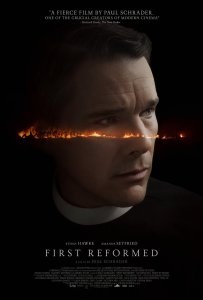
MV5BZDI1MGIyZDMtYjAyMy00ZWE1LTgzYjctYzM5MzczNjFjZWQwXkEyXkFqcGdeQXVyODQyNzE3MDg@._V1_Paul Schrader’s career is just astounding. Screen-writer for many of Scorsese’s masterpieces as Taxi Driver (1976), Raging Bull (1980), and The Last Temptation of Christ (1988), he is also a film critic, writer, and of course director of films like American Gigolo (1980) and Mishima: A Life in Four Chapters (1985). His filmography is exceptionally varied and somewhat erratic. Giorgio Moroder and David Bowie’s modern soundtrack didn’t save his horror remake Cat People (1982) for me, and his Canyons (2013) starring Lindsay Lohan and porn actor James Deen was just unbearable.

When I heard that First Reformed was Schrader’s return to form, I couldn’t help being both curious and sceptical.

I am pleased to say that even if flawed, First Reformed probably Schrader’s best and most personal work (since he almost became a priest himself) in at least 20 years. A movie filled with an insidious sense of despair, spiritual ordeal and hopelessness for the future that is comparable with behemoths of cinema as Bergam and Bresson.

Schrader seems to borrow elements especially from Bergman’s Winter’s Light (1963), where a Swedish pastor is suffering from a severe crisis of faith once confronted with God’s everlasting silence. Similarly, First Reformed is an intimate portrayal of a man of faith faced with devouring darkness, so intimate that it feels like we are peeping inside a confessional booth.

Set in present-day upstate New York, it follows the secretive life of Reverend Ernst Toller, custodian of the First Reformed Church, played superbly by Ethan Hawke who is on top of his game. He decides to start writing a personal diary as an experiment, where he shares with an invisible audience his struggle in adjusting to the increasing overlapping between church and capitalism. At the end of one year of writing, he will shred and burn the diary.

First Reformed Church became more of a gift shop than a place of spirituality, attracting more tourists than congregants. Only a handful of people are sitting on the white pews, listening to his sermons. Among those people, there is a young pregnant woman named Mary (Amanda Seyfried) whose sacred name can only add more layers to this film.

She approaches the Reverend after the service, asking him if he could talk to her depressed husband, Micheal. He is a radical environmental activist whose in-depth knowledge of the irreversible consequences of climate change destroyed his faith in the future. He doesn’t want to bring another child into this world. By the age of 33 (Jesus’ age at the time of his crucifixion), his daughter will be doomed to live in a world devastated by the greedy nature of our individualistic society. Rather than bringing some peace to Micheal, that conversation opens a dark spiralling hole inside Toller’s spirit, rekindling his grief for the death of his son who was killed during the Iraq war. “Will God forgive us for what we have done to his creation?”.
These words echo in the Reverend’s mind with relentless persistence. God is in every flower, every bee, every forest and coral reef. The planet is dying, and nobody seems to care. The “Abundant Life” corporate church not only appears to be completely clueless, but it is even sponsored by the mayor, governor, and a well-known industrialist, Edward Balq.

The Reverend is feeling alone and betrayed by his congregation.

As if that wasn’t enough, an aggressive cancer is spreading inside Toller’s body, similar to the looming devastation on planet Earth. He tries to post-pone a doctor’s appointment (a nod to humanity’s procrastination in facing the consequences of global warming). He is angry and in denial after the preliminary diagnosis (a nod to climate change deniers). His only cure for his physical and spiritual turmoil is alcohol. In one scene, we see him pouring candy pink Pepto Bismol in his whiskey. The image of this pink invasive mass, spreading inside this transparent liquid visually resembles the idea of a tumor, as well as the entropy effect that can only lead to a slow decline into chaos.

What do you do when there is no hope? Do you keep fighting or do you acknowledge the inexorable destiny? Should we keep trying to protect our planet, or maybe accept its premature deterioration?

Confined in a boxy aspect ratio (the same one used by Pawlikowski in Ida, 2013), Schrader’s approach is realistic and austere, nostalgic of an era of cinema that relied on its simplicity and not on superfluous embellishments. However, there are few surreal elements in stark contrast with the bleakness of the rest of the film. Without going into many details, there is a scene in particular where Mary and the Reverend will experience a sort of metaphysical connection. The scene fails to reach the cinematic resonance Schrader was hoping for, due to its preposterous editing which lies between the ludicrous and the extraordinary.

The climatic, eventful and abrupt ending will probably divide the audience as well.

It could be that Schrader didn’t know how to end it and couldn’t be bothered to write a final chapter. Or possibly, that his ending is instead very well- thought out, multi-layered and open to multiple interpretations. I prefer the latter option.

Is what happening on screen real or is it a manifestation of God? Is it a Miracle or the imagination of a dying man? Or is it just Heaven itself? Why is there a distracting eye-shaped lamp in Mary’s apartment?  It’s left to the bewildered audience to decide, and our answer might tell us how much faith in humanity and the future we have left within ourselves.

18firstreformed-facebookJumbo-v2_1530809861_crop_550x288

Movies you might like if you like First Reformed:

Diary of a Country Priest (1951) by Robert Breton

Winter’s Light (1963) by Ingmar Bergman

Breaking the Waves (1996) by Lars Von Trier

Ida (2013) by Paweł Pawlikowski